
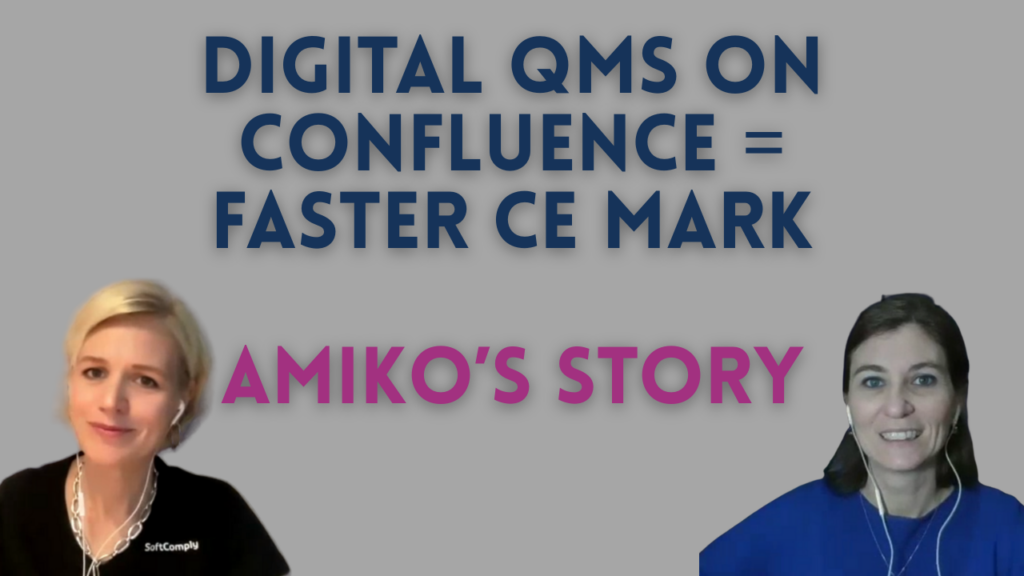

We recently sat down with Elisa Lo Blanco, Quality Assurance and Regulatory Affairs Manager at Amiko, a digital health company focused on chronic respiratory conditions, to discuss their journey to achieving CE marking under the Medical Device Regulation (MDR).
Amiko’s success highlights how MedTech startups can balance the need for regulatory rigor with the flexibility required in fast-moving, agile development environments.
Elisa shared her experience moving from clinical engineering to MedTech quality and regulatory affairs, driven by the belief that these disciplines ensure technology is safe, reliable, and truly usable, connecting directly to real patient impact. Amiko’s platform integrates smart inhaler sensors, a mobile application, and a clinical dashboard to provide real-world insights, supporting therapy management and optimizing clinical outcomes.
Check out the video interview in our YouTube channel:
The Regulatory Path: Moving from MDD to MDR
Achieving CE marking is a major milestone, confirming that Amiko’s product meets all required safety, performance, and regulatory standards for the European market.
Amiko’s regulatory journey began with understanding how the transition from the former MDD framework to the stringent MDR would impact their product, which was considered a legacy device. This required a rigorous process:
- Mapping regulatory requirements.
- Performing a Gap analysis across processes, technical documentation, and software development practices.
Amiko aligned its efforts with several key frameworks, including MDR 2017/745, ISO 13485 for QMS, and ISO 14971 for risk management. For software, they followed ISO/IEC 62304, and for cyber security, 81001-5-1.
Elisa noted that ISO 14971 (risk management) was particularly challenging for software engineers, as it requires linking patient risk directly to development activities and fostering a mindset focused on patient safety.
The Essential Need for a Digital QMS
A significant challenge for Amiko, as a startup, was balancing the need for regulatory robustness with the need to remain agile and avoid slowing innovation. This led them to identify the necessity for a structured and digitalized Quality Management System (QMS) early on.
Managing documentation manually would not have provided the required level of flexibility, control, or efficiency. They needed a validated solution capable of supporting electronic signatures and a complete audit trail, which became even more critical as the project grew.
Why Integrate your QMS with Jira and Confluence?
Many MedTech companies still rely on traditional tools like Word, Excel, or SharePoint for QMS documentation. Amiko’s engineering team, however, was already extensively using Jira for agile development.
Amiko sought a system that supported both compliance and their team’s existing workflow. They decided to build their QMS on Confluence, complementing Jira, to enhance the tools they already used rather than introducing a completely new system. This choice made the regulatory transition much smoother and more efficient.
“We built our compliance and documentation processes on top of tools the team already knew and used every day. This reduced the learning curve and helped make quality and regulatory activities a natural extension of the existing workflow”.Amiko chose SoftComply Document Manager because it provided a validated, compliant electronic Document Management System built directly on Atlassian tools, ready to support MDR requirements.
Integrating Compliance into Agile Workflows
By aligning regulatory requirements with agile development tools like SoftComply Document Manager, Amiko achieved significant benefits:
- Activities are now continually tracked and up to date.
- The team no longer accumulates documentation or compliance backlog.
- Compliance moves forward in parallel with development, not after it.
After the initial setup and analysis phase, SoftComply Document Manager became “almost transparent” for the team. Developers continue working in tools like Jira and GitHub, while Confluence automatically captures and controls the documentation, involving the development team only when a signature or approval is required. This centralized approach created a single shared repository – a “one point of truth” – that facilitated cross-functional collaboration.
Key Improvements to Document Control
The SoftComply Document Manager on Confluence Cloud provided concrete improvements to adherence to standards like ISO 13485:
- Controlled Versioning and Approvals: Managing document versions and approvals is now far more controlled, eliminating the risk of mixing drafts and approved documents. This directly supports ISO 13485 clause 4.2.
- Documentation Integrity: A critical learning moment for the development team was realizing that once a document is approved, it becomes locked and cannot be modified. Any correction must be made in a new version. This essential “forward-moving” logic ensures accountability and protects documentation integrity, a core requirement in regulated environments.
- Enhanced Traceability: The system simplifies the design and development documentation required by MDR Annex II (or ISO 13484 clause 7.3) because requirements, tasks, risk, and verification activities all live within the same ecosystem and are linked in real-time.
Audit Readiness by Default
A major benefit of having an integrated digital Document Management System on Confluence with the SoftComply Document Manager is the elimination of last-minute audit preparation stress.
“When every document is versioned and linked to the right evidence, you don’t have to prepare for an audit - you are audit ready by default”.
Amiko found that having a digital document management system meant they were no longer searching for the latest version or reconciling inconsistencies.
The auditors reviewing Amiko’s system were positively impressed, especially by the availability of the vendor’s validation package for the SoftComply Document Manager.
Key Lessons to Medical Device Startups on Compliance
Based on Amiko’s success and Elisa’s experience advising other startups, Elisa shared several crucial pieces of advice for organizations preparing for CE marking:
- Start Early: Structure your documentation and processes early, even in a lightweight form. Postponing this step leads to overwhelming rework later.
- Choose the Right Tools: Look for tools and workflows that fit the way your team already works. Avoid copying heavy processes from large legacy companies. For software developers using Atlassian tools, a Confluence-based solution like the SoftComply Document Manager offers an excellent cost-benefit balance, integrating compliance seamlessly.
- Integrate Quality Culture: Quality should not be treated as a separate function, but rather as something that grows together with the product. Involve the team early and explain the why behind regulatory requirements; when people understand the logic, adoption becomes much smoother.
- Documentation is Evidence, Not Paperwork: Startups must understand that documentation is the way they prove what they do – it is evidence of design decisions, risk mitigation, and safety commitments.
Achieving compliance is not a finish line: Amiko’s future priorities include strengthening post-market activities, scaling the QMS as the team grows, and preparing for global market expansion, including aligning with FDA requirements.
For startups considering digital QMS solutions, Amiko’s journey demonstrates that building a compliant, validated system directly on existing agile tools like Confluence together with SoftComply can deliver the necessary rigor and efficiency without disrupting development workflows.
Want to learn more about the SoftComply Document Manager? Schedule an intro call with our team: https://calendly.com/softcomply/eqms